Almost 200 years ago, Sir Richard Owen (of Dinosauria fame) remarked that some reptiles have teeth set in deep sockets in their jaws, and he argued that these animals were thus closely related. While this relationship has long since been discredited, the word Owen used to describe this feature has lived on: ‘thecodont‘. Since that time, thecodont has acquired quite a bit of baggage that dilutes it from its original meaning. Returning the word to its former glory is the goal of a recent paper led by my friend and colleague Gabriel Mestriner Da Silva.
Why is this important? Two bits of context help. First, the way that teeth anchor themselves in the jaws is surprisingly variable among toothed critters, and tells us important things about their evolution. So it’s actually pretty important to be consistent with how we interpret the tooth-jaw interface. Second, we can break tooth-jaw interaction down into two finer components: the shape of the attachment, and the strength of that attachment. For example, despite being closely related, chameleons have teeth that sit on top of the jaw, and Komodo Dragons have teeth sort of stuck onto the side of the jaw; two different shapes of attachment (or ‘implantation’ styles). At the same time, we might also observe that both of those lizards have their teeth fused to the bone, whereas our teeth are suspended by a soft ligament (different ‘attachment’ styles).


So where does ‘thecodont’ come into this? It just so happens that the two main living lineages with deep sockets (thecodont implantation), mammals and crocodiles, also both have teeth attached by soft ligaments. Because of this, thecodonty has come to be popularly used to mean teeth both in sockets and with a soft ligament attachment. That is, it describes both implantation and attachment. This is especially important because for a long time we thought that the ligamentous attachment in mammals was a key adaptation that helped us develop complex chewing teeth, and so it was mysterious why it would have evolved independently in crocodiles, which have pretty much the opposite (although see a cool new croc with more mammal-like teeth, also published today!).
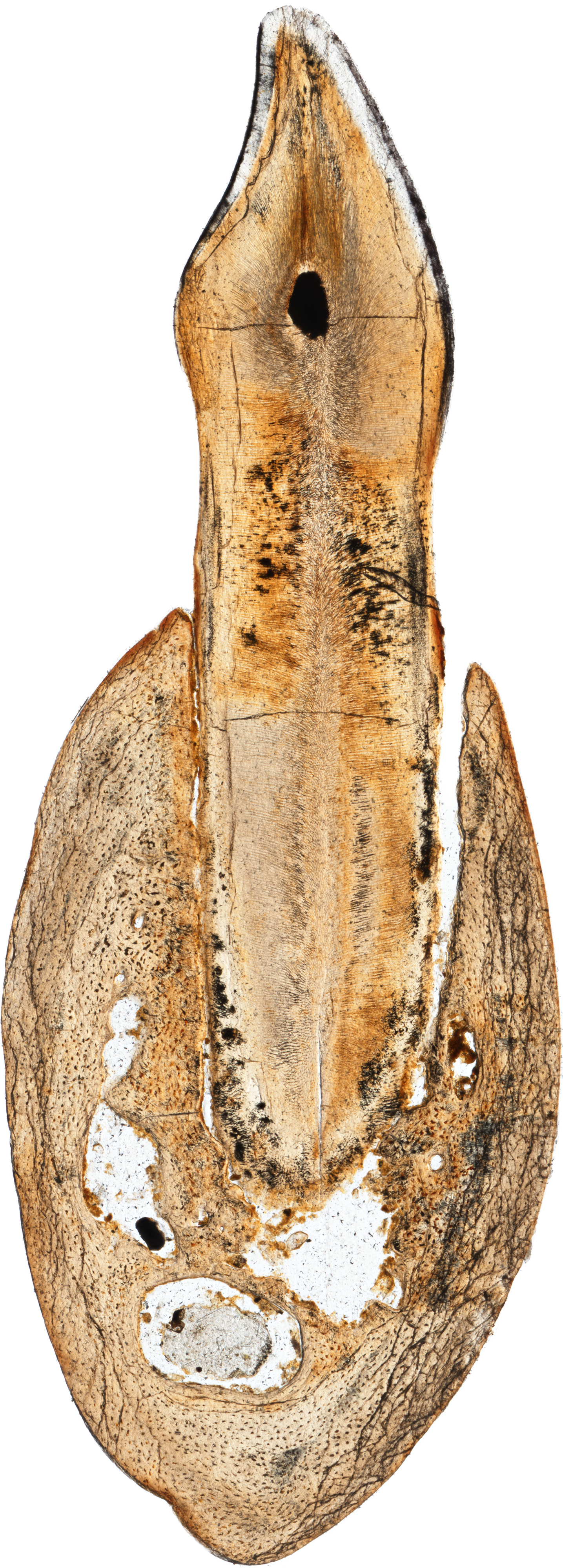

This mystery has, over the last ~10 years, been completely turned on its head by the discovery that fused attachments and ligamentous attachments aren’t actually so different after all. In fact, fused teeth previously had ligaments, which progressively mineralized to become a bone-like tissue. Surprisingly, all teeth have the same tissues, regardless of how they implant or attach. And that means that compound terms like ‘thecodonty’ are just the result of coincidence, so using them in this way muddies the water and–for nearly 200 years–has misled us about the relationship between tooth implantation and attachment.
Gabriel’s paper completely disentangles all of these complex issues and baggage, and proposes a straightforward solution: we drop the attachment aspect of thecodonty and return to our roots (pun entirely intended). Our suggestion is that thecodonty be used solely to refer to teeth deeply implanted in sockets (with derivative terms describing how symmetrical the sockets are), and that we leave ligaments and fusion out of it. After all, we already have a spectrum to describe tooth fusion, from ankylosis (fully fused) to gomphosis (soft ligament). Our hope is that clarifying this terminology lets us refocus on the evolutionary questions without projecting any preconceived notions onto them.


 Greg Funston Palaeontology